Turnitin flagged my essay as AI. What now?
The score is a guess about your words, not evidence about you. Turnitin says so itself.
If Turnitin flagged your essay as AI and you wrote it yourself, the most useful thing to know is that the score isn’t an accusation. It’s a prediction. Turnitin’s own reports say the score may misidentify human writing and shouldn’t be the sole basis for action against a student.[1]
So the question in front of you isn’t “how do I argue with a number?” It’s “how do I show how I wrote this?” That’s a much better question, because it has an answer.
Short answer: ask to see the report, gather evidence of how you wrote the essay, offer to talk through it, and ask for a decision based on that evidence rather than the score.
What the number actually measures
An AI detector reads your finished essay and asks one question: how predictable is each word, given the words before it? AI writing tends to be predictable, because predicting the next word is literally how it’s made.
The trouble is that a lot of human writing is predictable too. Clear writing is predictable. Writing by people who learned English as a second language is often predictable: in one Stanford study, popular detectors flagged 61% of essays by non-native English writers as AI.[2] And an essay that follows the five-paragraph template your school taught you is very predictable indeed.
Turnitin knows this. Since July 2024 it hides scores between 1% and 19% behind an asterisk instead of showing a number, because low scores produce more false positives.[3] It also publishes its own error rates: under 1% of whole documents wrongly flagged, for documents it thinks are at least 20% AI,[4] and about 4% of highlighted sentences that are actually human-written.[5]
Under 1% sounds small. It isn’t, at Turnitin’s scale.
The first number is Turnitin’s own.[6] The second is just multiplication. The third is Vanderbilt’s, which did the same sum for its 75,000 papers a year and turned the detector off.[7]
What to do this week
- Don’t panic, and don’t admit to something you didn’t do. A calm, specific reply works better than an angry one.
- Ask for the report. Which passages were highlighted, and what was the score?
- Gather your evidence. Version history, drafts, notes, outlines, sources, your browser history from the research. Google Docs version history helps, though it has limits.
- Offer to talk it through. Explain your argument, your sources and how you got there.
- Read the policy. Check what your school says about AI and about detector results. Many say a score alone isn’t enough.
- Ask for a decision based on evidence, and quote Turnitin’s own disclaimer if you need to.
The strongest of these is the one most people skip: offering to talk. Someone who wrote an essay can explain why paragraph three comes before paragraph four. Someone who didn’t usually can’t. It’s an old-fashioned test, and it’s still the best one. Our guide Flagged by an AI detector? goes through each step in more detail.
How to never be here again
The real problem isn’t the score. It’s that when the score arrived, you had no evidence ready. Most of the evidence students reach for is weak in one way or another:
| Evidence | What it shows | What it doesn’t |
|---|---|---|
| Turnitin AI score | A prediction from the finished text | How you wrote it |
| Version history | Saved snapshots over time | Every key press, or what was pasted |
| Drafts and notes | Your thinking along the way | When they were made |
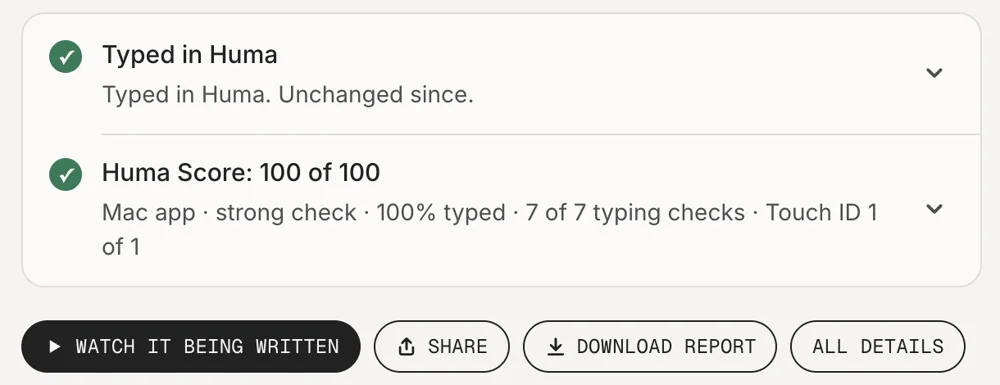
| Huma link | Every key press with its timing, what was typed and what was pasted; anyone can check it | Where your ideas came from |
Write your next essay in Huma, press Finish, and attach the link when you submit. Your teacher opens it in any browser, with no account, and sees something like this:
Questions
Can Turnitin be wrong about AI?
Yes. Turnitin says about 4% of highlighted sentences are actually human-written, and its reports say the score shouldn’t be the sole basis for action against a student.
What does an asterisk mean on Turnitin’s AI score?
Since July 2024, Turnitin shows an asterisk instead of a number for AI scores from 1% to 19%, because low scores are less reliable.
How do I prove I didn’t use AI?
Show how you wrote it: version history, drafts and notes, or a Huma link that shows every key press, which your teacher can open and check in a browser.
Notes
- Michigan State University, “Turnitin AI Detection” (quoting the disclaimer on Turnitin’s reports). help.d2l.msu.edu
- Liang, Yuksekgonul, Mao, Wu and Zou, “GPT detectors are biased against non-native English writers”, Patterns, 2023. arxiv.org
- Turnitin Guides, “AI writing detection in the classic report view”. guides.turnitin.com
- Turnitin, “AI writing detection update from Turnitin’s Chief Product Officer”. www.turnitin.co.uk
- Turnitin, “Understanding the false positive rate for sentences of our AI writing detection capability”. www.turnitin.co.uk
- Campus Technology, “Turnitin Says Its AI Detector Analyzed 38M Submissions in Six Weeks”, May 2023. campustechnology.com
- Vanderbilt University, “Guidance on AI Detection and Why We’re Disabling Turnitin’s AI Detector”, August 2023. www.vanderbilt.edu