Alternatives to AI detectors for teachers
A detector score can’t tell you how a student wrote something. Asking them can.
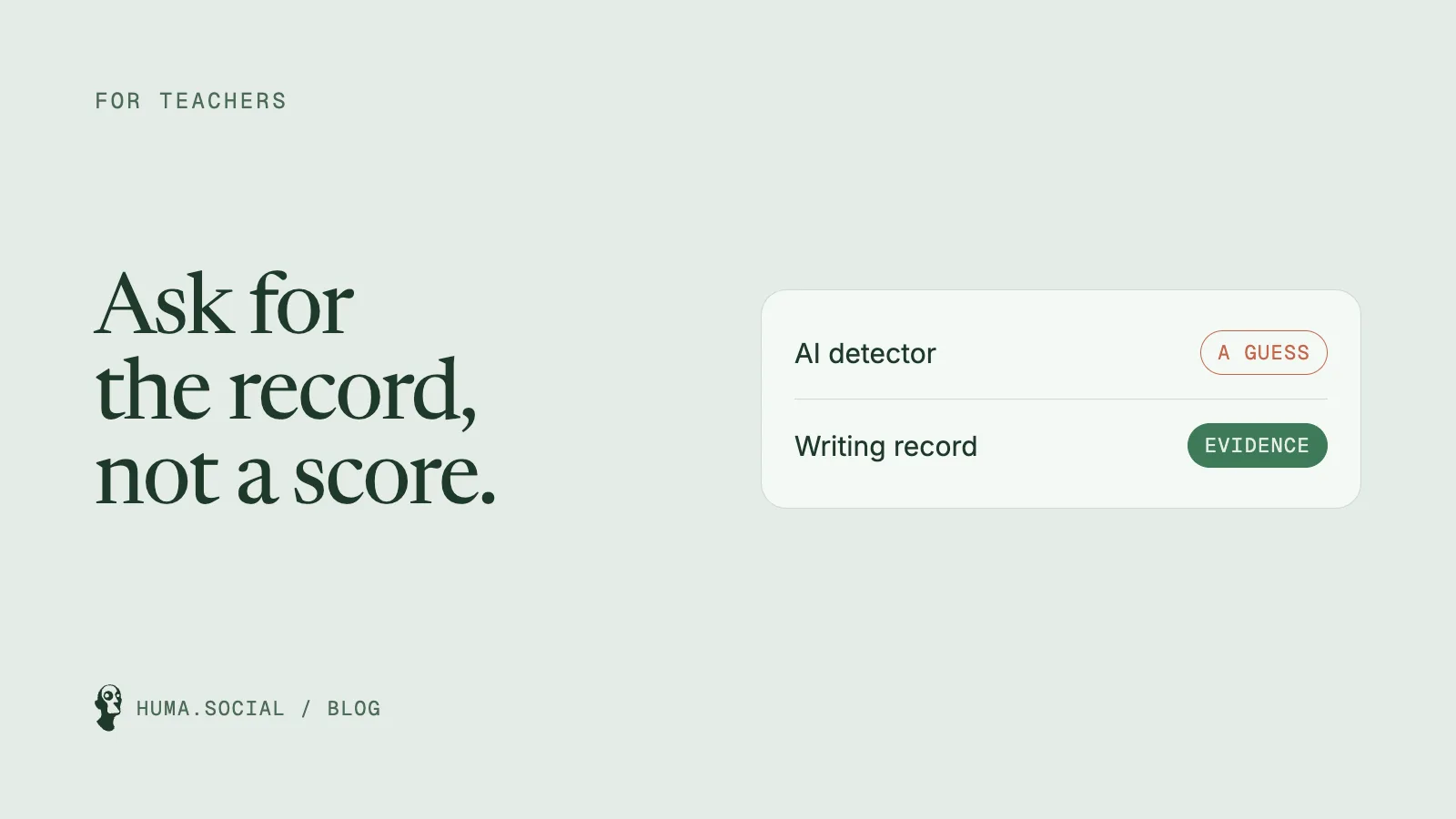
Teachers didn’t ask for this problem. Five years ago, if a student handed in an essay, the student had written it, or a friend had, or it was copied from somewhere you could find. Now any student can get a competent essay in seconds, and the tools sold to catch that are guesses.
It matters more than it might seem. Paul Graham argues that as AI takes away the pressure to write, the world will split into people who can write and people who can’t, and since writing is thinking, into people who can think and people who can’t.[1] He quotes Leslie Lamport: “If you’re thinking without writing, you only think you’re thinking.” Teaching students to write is now also teaching them to think, on purpose. Which makes it more important, not less, that we can tell when they did.
Short answer: instead of relying on a detector score, ask students to show how they wrote: a Huma link, version history or drafts. Talk to students about their work, write in class sometimes, and set a policy that says a detector score alone isn’t evidence.
Why a detector score isn’t enough
Turnitin’s own reports say its AI score may misidentify human writing and shouldn’t be the sole basis for adverse actions against a student.[2] Vanderbilt turned Turnitin’s AI detector off after working out it could wrongly flag about 750 of its 75,000 papers a year.[3] And detectors flag non-native English writers far more often than native ones.[4]
A wrong accusation costs a student’s trust and your time. But the worst thing about a score is that it gives an honest student nothing to show back. A guess can only be argued with.
What works instead
- Ask for the process, not just the essay. A Huma link shows every key press with its timing, and what was typed and pasted. Version history and drafts help too.
- Talk to the student. Someone who wrote an essay can explain their argument and their sources.
- Write in class sometimes. A short in-class piece gives you a sense of each student’s voice.
- Grade the process. Give credit for outlines, drafts and revisions, not just the final essay.
How to ask for a Huma link
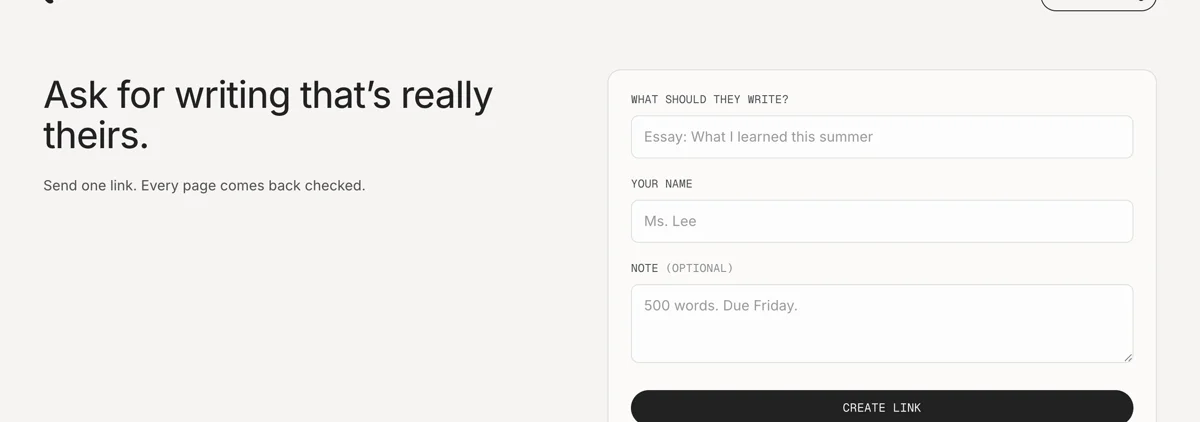
- Go to huma.social/ask, write what students should write, and press Create Link.
- Send that link to your class, and save your inbox link.
- Students write in Huma and press Finish and Send. Every page comes back to your inbox, already checked.
It’s free for students. They don’t need an account to start writing, and you never need one to read their links.
What normal writing looks like
Real writing is messy: pauses, deleted sentences, rewrites, jumping back to fix a paragraph. Paul Graham describes rereading drafts of an essay dozens of times;[5] students do a smaller version of the same thing. Pasted text is marked as pasted, so a big block that arrived all at once stands out. Huma stops recording if text appears without a person typing it, and gives a lower Huma Score when the typing doesn’t look like a person’s.
A policy you can copy
“An AI detector score alone is not evidence of misconduct. Students may include a Huma link, version history or drafts with any submission to show how it was written. Before any decision, the student will have a chance to explain their work.”
What Huma can’t do
Huma shows how text was typed. It doesn’t judge quality, and it can’t tell where an idea came from: a student could type out something they read elsewhere. The replay’s timing helps you spot that, but a short conversation is still the best check.
Questions
How can teachers tell if a student used AI?
Ask students to show how they wrote: a Huma link that shows every key press, version history or drafts. Then talk to the student about their work. A detector score alone isn’t evidence.
Should teachers use AI detectors?
Turnitin’s own reports say its AI score shouldn’t be the sole basis for action against a student, and some universities, such as Vanderbilt, have turned AI detection off.
Is Huma free for students?
Yes. Free includes 10 documents, students don’t need an account to start writing, and teachers never need one to read a Huma link.
Notes
- Paul Graham, “Writes and Write-Nots”, October 2024. paulgraham.com
- Michigan State University, “Turnitin AI Detection” (quoting the disclaimer on Turnitin’s reports). help.d2l.msu.edu
- Vanderbilt University, “Guidance on AI Detection and Why We’re Disabling Turnitin’s AI Detector”, August 2023. www.vanderbilt.edu
- Liang, Yuksekgonul, Mao, Wu and Zou, “GPT detectors are biased against non-native English writers”, Patterns, 2023. arxiv.org
- Paul Graham, “Putting Ideas into Words”, February 2022. paulgraham.com