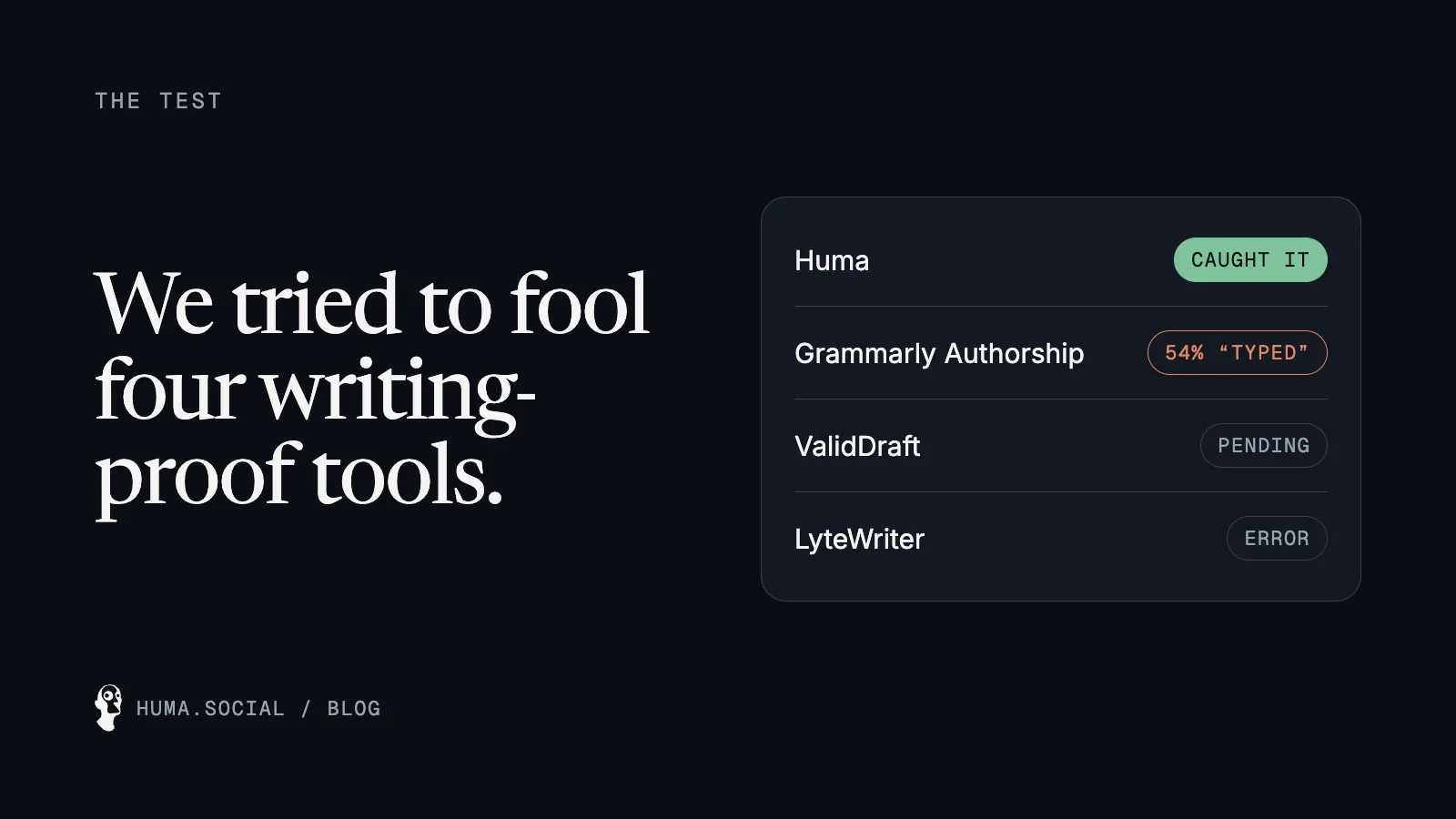
We tried to fool four writing-proof tools. Only Huma caught it.
An AI agent, a simple typing script, and four tools that say they can prove a person wrote something.
There’s a new kind of software that says it can prove a person wrote something. Not by reading the text and guessing, the way AI detectors do, but by watching the text get written. I think this is the right idea. Guessing from finished words was always going to fail, for reasons I’ll get to in another post. Watching the writing happen gives you evidence instead of an opinion.
But a right idea can still be built badly. So on November 5, 2026, we tried to fool four of these tools, including our own. Huma was the only one that caught every attempt.
Short answer: an AI agent put AI-written text into Huma, ValidDraft and LyteWriter. Huma stopped it the moment the text appeared; ValidDraft issued a certificate ID marked “Pending review”; LyteWriter’s check failed with an error. Then a simple script typed a paragraph copied from Pride and Prejudice, one character at a time. Grammarly Authorship labelled 35% to 54% of it as typed by a person. Huma stopped the same script within the first sentence.
The first test: let an AI agent do it
The laziest way to cheat one of these tools is to have software put the text in for you. So we gave an AI agent, Claude running in Chrome, a short AI-written bio and asked it to enter the text into each app and run the app’s check.
When we asked it to go further and type word by word with human-like pauses, it refused. It said it wouldn’t help fake a human-writing result. That’s the right call for an AI model to make, and it meant this first test only covered the crude version: text that shows up in the editor all at once.
| App | What happened | Caught it? |
|---|---|---|
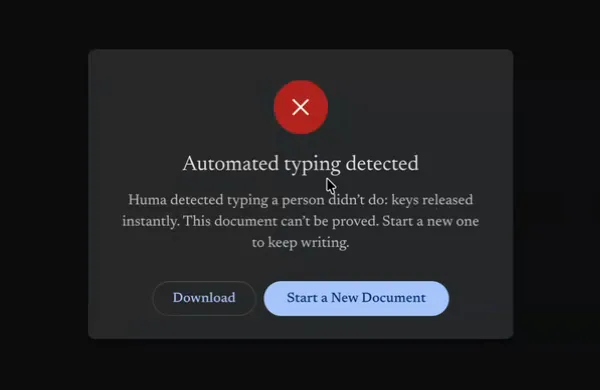
| Huma | Stopped recording as soon as the text appeared; no proof possible | Yes |
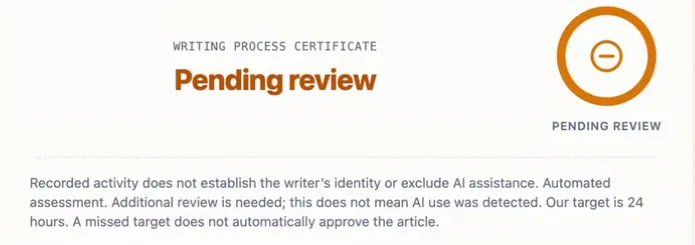
| ValidDraft | Accepted it and issued a certificate ID, marked “Pending review” | No |
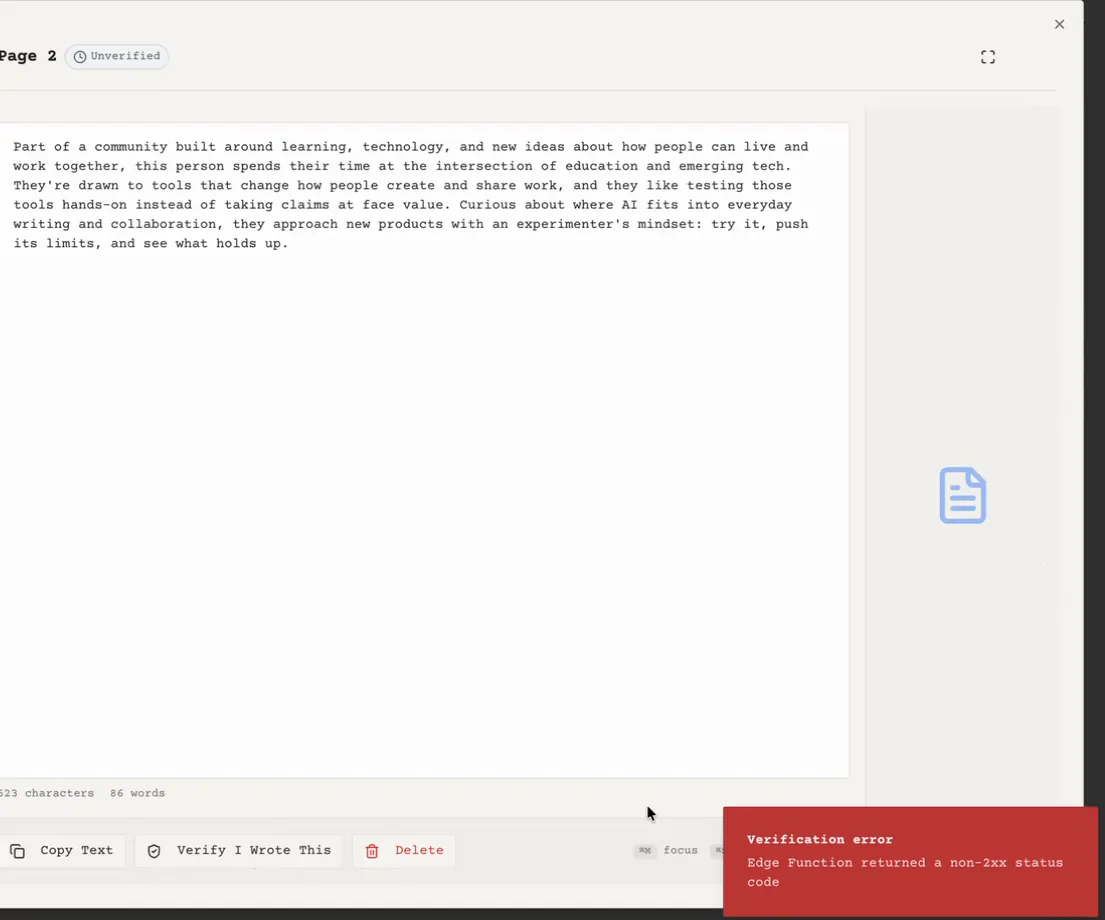
| LyteWriter | Saved it as “Unverified”; the check failed with an error | No |
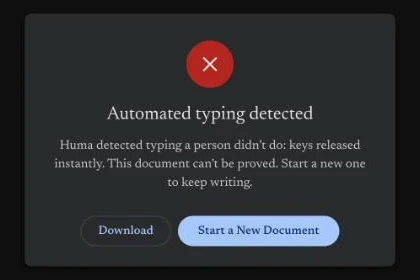
Huma stopped recording and said: “Huma detected typing a person didn’t do: keys released instantly. This document can’t be proved.”
ValidDraft accepted the submission and created a certificate with its own ID. Its status was “Pending review”, with a note that a person would look within 24 hours. To be fair, that person may well reject it. But the automatic check didn’t notice a 515-character paragraph arriving in a single insert, and a certificate existed straight away.
LyteWriter saved the document as “Unverified”, and when we pressed “Verify I Wrote This” it showed a server error. So we got no answer either way. It may work on another day. On the day we tested, it didn’t.
The second test: a simple typing script
A determined cheater wouldn’t use an AI agent. They’d use a script that types for them. So we wrote one: it types one character at a time, pauses between words, makes the occasional typo and fixes it with backspace. Nothing clever. The kind of thing you could write in an afternoon.
And we gave it something it shouldn’t be able to pass off as human: the opening paragraph of Pride and Prejudice, copied word for word.[1] If a tool labels that “typed by a person”, it isn’t just missing AI. It’s certifying copying.
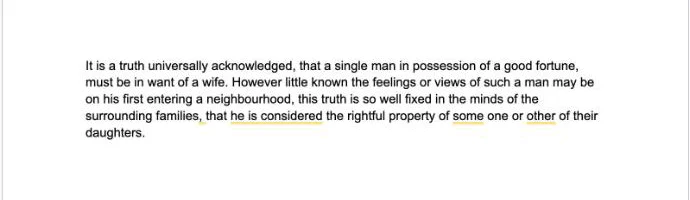
We ran it in a Google Doc with Grammarly Authorship, which records how a document is written,[2] then generated Grammarly’s report. We did that twice. Then we ran the same script in Huma.
| Tool | Result |
|---|---|
| Huma | Stopped within the first sentence: “Automated typing detected… This document can’t be proved.” |
| Grammarly Authorship, run 1 | 54% “Typed and unmodified”, 46% “Copied or generated” |
| Grammarly Authorship, run 2 | 35% “Typed and unmodified”, 65% “Copied or generated” |
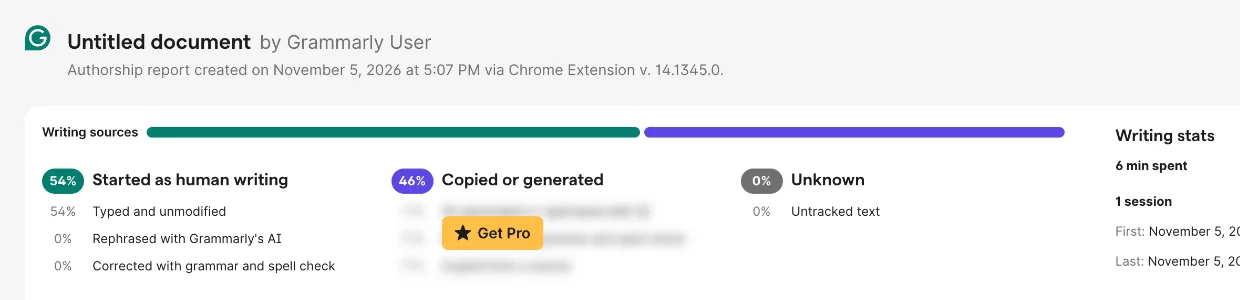
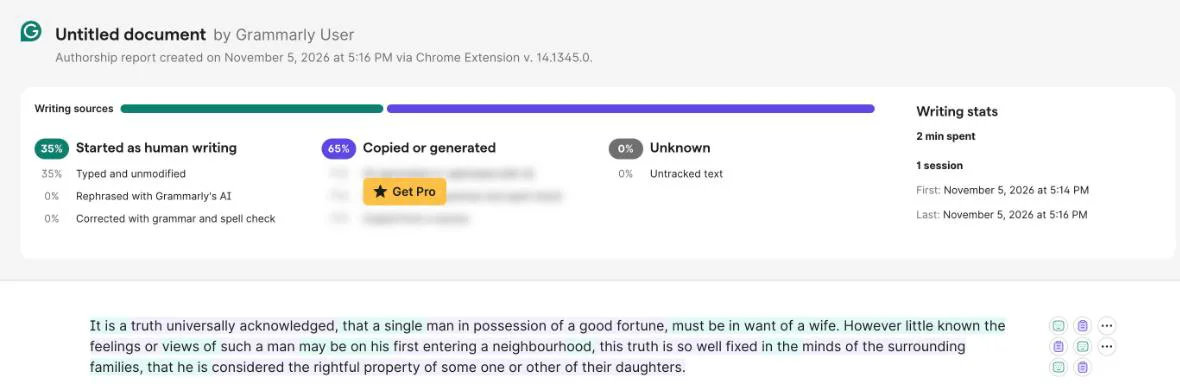
Grammarly caught part of it both times, and it’s worth saying so. But a third to a half of a 200-year-old novel, typed by a script, came out labelled as typed by a person. That isn’t the first time someone has found a gap like this: Plagiarism Today found that text rewritten by Grammarly’s own Humanize feature was labelled “Typed by a Human”.[3]
Why the difference?
The difference is in what each tool treats as the evidence. Grammarly labels stretches of text, so a script that types slowly enough gets some of its stretches called human. Huma treats the whole writing session as one piece of evidence. It records every key press with its timing and checks that the timing could have come from human hands. A script sends key presses, but not the way fingers do: it releases keys instantly, for example. When Huma sees that, it stops, and that document can never become a proof.
When Huma does make a proof, it’s made on your own device, and anyone can check it at huma.social/verify without trusting us. That matters more than it sounds. A label that says “typed by a human” is only as good as the company printing it.
What this doesn’t show
- We make Huma. Every screenshot here comes from a continuous screen recording of the tests, and you can run the same tests yourself.
- A few runs, on one day. Grammarly’s results varied between runs (54% and 35%), so we show both. Apps change. If you make one of these tools and something has changed, email team@huma.social and we’ll test again and update this post.
- No tool is unbeatable. Someone could build a much better typing robot than our afternoon script. Huma shows the timing of every key press in its replay, so unnatural typing is visible to a reader, but no one should claim their tool can’t be fooled. We don’t.
Questions
Can an AI agent fake a writing proof?
It depends on the tool. In our test on November 5, 2026, an AI agent put AI-written text into three writing-proof apps. Huma stopped it immediately, ValidDraft issued a certificate ID pending review, and LyteWriter’s check failed with an error.
Can Grammarly Authorship be fooled by a typing script?
In our test, a simple script typed a paragraph copied from Pride and Prejudice one character at a time. Grammarly Authorship labelled 54% of it “Typed and unmodified” in one run and 35% in another. Huma stopped the same script within the first sentence.
Which tool proves you wrote something?
Tools that record writing as it happens, such as Huma, Grammarly Authorship and Turnitin Clarity, give evidence instead of a guess. Of the four tools we tested, Huma was the only one that caught every attempt.
Is Huma free?
Yes. Free includes 10 documents, and the Chrome extension is free.
Notes
- Jane Austen, Pride and Prejudice (1813), public domain, Project Gutenberg. www.gutenberg.org
- Grammarly, “Grammarly Authorship”. www.grammarly.com
- Plagiarism Today, “How Grammarly Launders AI-Generated Content”, November 2025. www.plagiarismtoday.com